HOW TO USE THE DICTIONARY
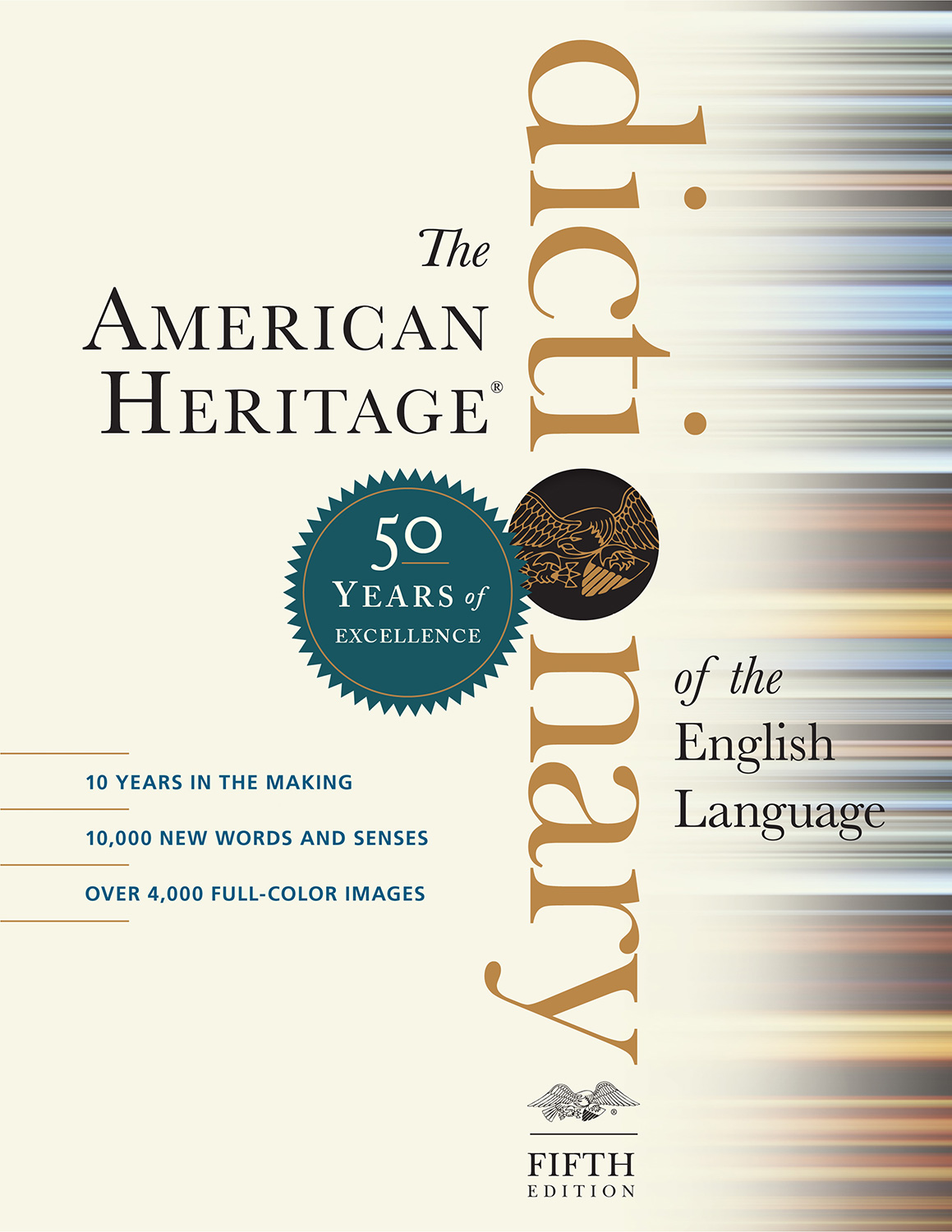
To look up an entry in The American Heritage Dictionary of the English Language, use the search window above. For best results, after typing in the word, click on the “Search” button instead of using the “enter” key.
Some compound words (like bus rapid transit, dog whistle, or identity theft) don’t appear on the drop-down list when you type them in the search bar. For best results with compound words, place a quotation mark before the compound word in the search window.
THE USAGE PANEL
The Usage Panel is a group of nearly 200 prominent scholars, creative writers, journalists, diplomats, and others in occupations requiring mastery of language. Annual surveys have gauged the acceptability of particular usages and grammatical constructions.

AMERICAN HERITAGE DICTIONARY APP
The new American Heritage Dictionary app is now available for iOS and Android.

THE AMERICAN HERITAGE DICTIONARY BLOG
The articles in our blog examine new words, revised definitions, interesting images from the fifth edition, discussions of usage, and more.

INTERESTED IN DICTIONARIES?
Check out the Dictionary Society of North America at http://www.dictionarysociety.com
v. an·tic·i·pat·ed, an·tic·i·pat·ing, an·tic·i·pates v.tr. 1. a. To see as a probable occurrence; expect: We hadn't anticipated the crowds at the zoo. I anticipated that you might be in a hurry. b. To think of (a future event) with pleasure; look forward to: She anticipated a pleasant hike in the country. 2. a. To deal with beforehand; act so as to mitigate, nullify, or prevent: We anticipated the storm by boarding up the windows. See Synonyms at expect. b. To react to (someone) abruptly, especially to prevent someone from continuing or progressing: "Immediately he regretted his words and started to add: 'I didn't know you lived out this way.' But Bloekman anticipated him by asking pleasantly: 'So how's your wife?'" (F. Scott Fitzgerald). c. To act in a way that blocks or vitiates the action of (another): "Professor Thomson had anticipated me and had obtained many patents on this principle" (Nikola Tesla). 3. To serve as a forerunner to or previous indication of: Her research in the previous decade anticipated these findings. 4. To use in advance, as income not yet available. 5. To pay (a debt) before it is due. v.intr. To think, speak, or write about a matter in advance. [Latin anticipāre, anticipāt-, to take before : ante-, ante- + capere, to take; see kap- in the Appendix of Indo-European roots.] an·tici·pat′a·ble adj. an·tici·pa′tor n. an·tici·pa·to′ry (-pə-tôr′ē) adj. Usage Note: Traditionally, the verb anticipate has been used to mean "to deal with in advance, to forestall" (as in We anticipated the storm by boarding up the windows, which was accepted by 70 percent of the Usage Panel in 2014). Some commentators have frowned on the more recent usage that means "expect or look forward to," as in He is anticipating a visit from his son. But this usage has become increasingly accepted, with approval rates that grew from 62 percent in 1964 to 87 percent in 2002 and 95 percent in 2014. Even when the anticipated event is expressly stated to be positive, with no possible need for preventive or compensatory measures, as in We are anticipating a pleasant hike in the country, 93 percent of the Panel approved the usage (up from 81 percent in 2002). The fact that the Panelists now rate the "expect" sense higher than the "forestall" sense shows that the newer one is actually supplanting the old as the primary meaning of anticipate. There is a third sense, "to act in a way that blocks or vitiates the action of another" as in I ran to answer the doorbell but found my brother had anticipated me and let the guests in, where the object of anticipate is the one whose plans are rendered unnecessary rather than the plans themselves. A bit more than half of the Usage Panel accepted this sense of the verb, which is best considered uncommon but acceptable. |

The American Heritage® Dictionary of the English Language, Fifth Edition copyright ©2022 by HarperCollins Publishers. All rights reserved.